

This weekend, I saw my sister get hit by a torrent of abuse, shame and blame.
I watched without moving a muscle.
Then I opened my eyes and saw her resting peacefully, reading her book. It had all been in my mind.
I had found a quiet spot to process my thoughts and feelings rather than just push them down or let them erupt. To acknowledge the lump in my throat and the self-pity party taking place in my mind.
To witness my triggers expand and explode, and over what?
I’d been sharing some personal stuff and I saw my sister switch off. Mentally disengage. Walk away.
“I mean how selfish!”
“Just like dad!”
“My sisters are supposed to be there for me.”
“I carry everyone, but who cares for me?”
Yada yada yada.
Boo hoo!
It made me feel terrible. Like it was poisoning my time with her. But I couldn’t help it. My mind was going there anyway, so I thought “what a great opportunity!”
Why Family Are the Easiest Trigger of All
Family are funny. They present the easiest, most automatic and easily available triggers. All those jaded assumptions ready for our wounded ego to pounce on.
To take things personally.
And once in a while, you get to watch this process in action. Like a really bad t.v. soap opera, with a melodramatic and predictable script.
So I watched the parade of thought – emotion – response cross my mind and body. Remembering to:
- Not judge
- Not indulge
- Not suppress
- Not try and fix.
To just experience the emotions and let them arise, abide and subside.
At first it felt heavy, then progressively lighter.
By the end of it, I was wondering what all the fuss was about.
How to Let Emotions Arise, Abide and Dissolve: A Mindfulness Practice
Being able to sit with your emotions is a powerful practice.
To step back and let your feelings be felt, without making them wrong, somehow loosens the charge.
Diffuses the trigger.
In the moment, it helped me see that my sister wasn’t being selfish or uncaring. She simply did not have the capacity to hold space for me as she was feeling emotionally vulnerable and dysregulated herself.
And where I normally would have acted out of hurt, I was able to stop putting fuel on a fire that burns us both
There was simply no spark of ill will left.
If you want to try this practice out yourself, this video will guide you.
The Fact or Fiction Exercise: Separating What Happened From What You’re Making It Mean
Another technique I love, I call the “fact or fiction” exercise.
It’s great for conflict management – with our colleagues, our family or with ourselves.
Grab a sheet of paper and create the following 2 columns:
- Fact: what objectively happened – then chronologically list the relevant information, as if you were documenting a video recording.
- Fiction: the stories you tell yourself about it – now list what you are making it mean to you; the fiction and the emotional response.
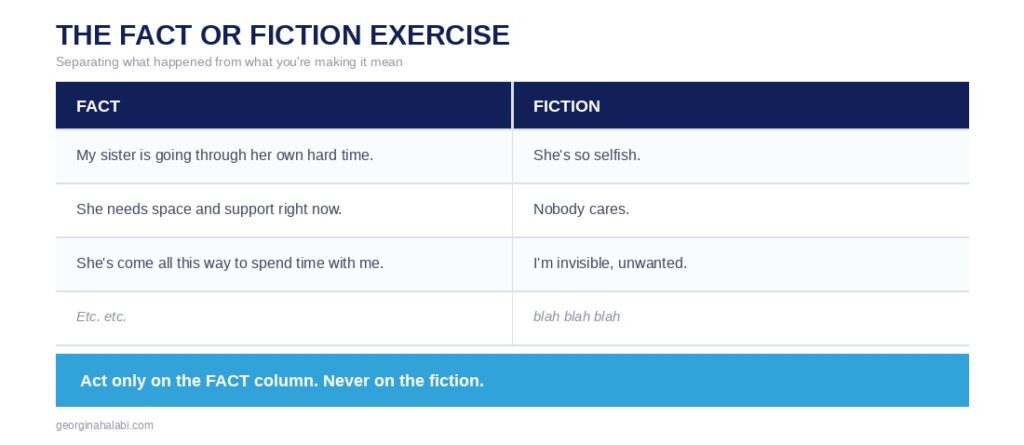
Once done, review the document and notice what comes up for you. After all, it’s not often you get to peel back the curtain of your own destructive self-talk, and see the wizard gleefully spinning the wheels behind it.
Then always make sure you only act on the fact column. Never the fiction.
You Are Not Your Thoughts
Don’t worry, we all have these negative self-talk loops in our heads.
Our wounds and programming keep us reacting – even if we’re doing our best.
It’s a reflex.
An infinite jest we play on ourselves.
As both the puppet and the puppeteer.
So go easy on yourself, and remember, you are not your thoughts. You are the vast consciousness experiencing them.
And when you come from that space, you have choice.
How amazing is that?
p.s. It’s easier to see the blind spots in others than in ourselves. If you’re feeling stuck, and would like some support – reach out. I’d love to help.


